
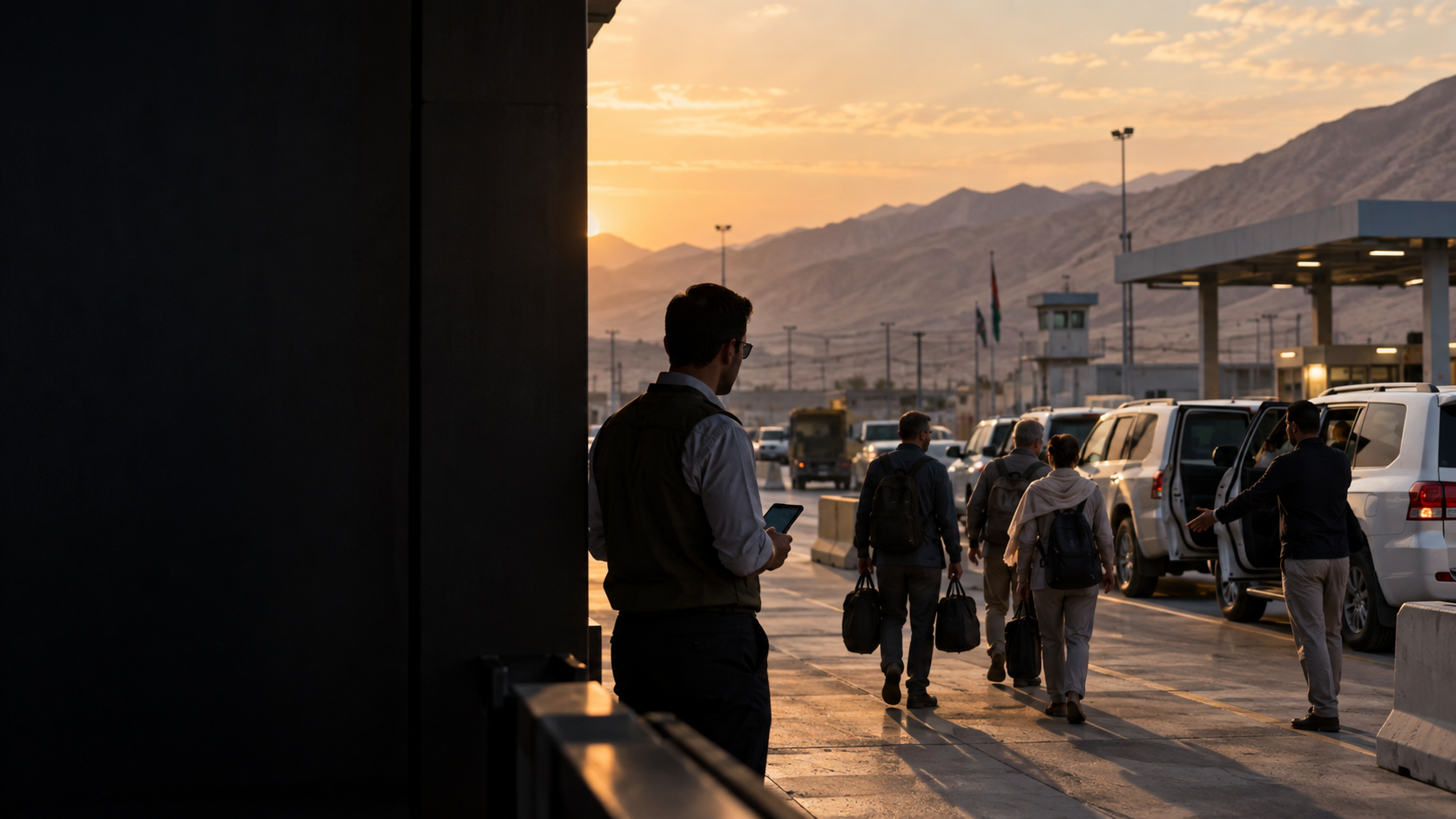
Evacuation & Crisis Management in the Middle East
Regional instability in the Middle East can close airspace, disrupt commercial aviation, restrict border movement and affect several countries simultaneously. An evacuation that appears straightforward on paper can quickly become a multi-stage journey.
Effective crisis management therefore depends on more than identifying a route out. It requires an understanding of how the wider regional transport system is functioning, where travellers are located, which borders remain viable and how quickly those conditions may change.
In 2026 alone, Stratum Global Risk supported the evacuation of more than 1,000 individuals across the Levant and every GCC country, often through multi-country routes and multiple land borders.
The Middle East Operates as a Connected Region
One of the defining characteristics of evacuation planning and crisis management in the Middle East is the way disruption in one country can immediately change movement options elsewhere. A closure affecting Gulf airspace can alter flight availability across several neighbouring states. Instability in the Levant can place additional pressure on land borders, accommodation and transport networks well beyond the country where the original incident is taking place. For that reason, emergency evacuation planning cannot always be treated as a collection of separate national plans.
A traveller leaving Lebanon may ultimately need to move through Syria and Jordan before reaching a reliable point of onward departure. Movement from Israel or the Palestinian Territories may depend on access into Jordan. Disruption affecting the UAE or Bahrain may make overland movement toward Oman or Saudi Arabia relevant. Each stage of the journey introduces different considerations: transport, immigration, border procedures, security conditions, accommodation and onward travel capacity.
A Regional Response in 2026
The scale of regional disruption during 2026 illustrated how quickly an evacuation can become a cross-border coordination problem. During the year, Stratum Global Risk supported the evacuation of more than 1,000 individuals from across the Levant and every GCC country. These movements were not delivered through one standard evacuation model.
Some travellers were able to continue using commercial aviation after being repositioned to another airport. Others required road movement toward neighbouring countries before flights became available. Certain routes involved several stages, with travellers moving across more than one national border before reaching a stable point of departure.
Routes supported during the year included movement from Syria into Jordan, from the Palestinian Territories toward Jordan, movement from the UAE toward Oman, from Bahrain into Saudi Arabia, and overland corridors linking Lebanon, Syria and Jordan. In many cases, the most difficult part of the response was not the physical movement itself.
The challenge was understanding where people were located, which routes remained viable, whether border procedures had changed, where vehicles could be positioned and whether onward travel would still be available once travellers reached the next country. This is the reality of regional evacuation: the first successful movement is often only the first part of the journey.
Cross-Border Movement Changes the Problem
Once an evacuation moves across an international border, the nature of the operation changes. Transport providers may need to change. Vehicles permitted to operate in one country may not be able to continue into the next. Drivers may require different permissions. Travellers may be subject to visa or transit requirements that are irrelevant during normal air travel. A neighbouring country may provide immediate safety but still not be the final destination.
Travellers may need to remain temporarily in Amman, Riyadh, Muscat or another regional hub while commercial flights are rearranged. Accommodation, airport transfers and onward booking therefore become part of the crisis response rather than separate travel-management tasks. For this reason, good evacuation planning needs to look beyond the border crossing itself. The important question is not simply, “How do we get people out?” It is, “Where can we move them, what happens when they arrive, and how do we continue the journey from there?”
Commercial Aviation Remains Central
Evacuation does not automatically mean chartering an aircraft. In many regional crises, commercial aviation remains the most efficient and appropriate method of onward travel, even when normal routes have been disrupted. The difficulty is often reaching an airport where suitable commercial capacity still exists.
Road movement may therefore be used to reposition travellers into another country, after which scheduled flights can continue the evacuation. This combination of ground transport and commercial aviation is frequently more practical than relying on specialist aircraft, particularly when large numbers of travellers are moving at the same time. Charter aviation has an important role in certain circumstances, but it is one tool within a much wider crisis-response system. The objective should always be to identify the most appropriate movement solution rather than the most dramatic one.
Crisis Management Starts Before Anyone Moves
The most effective evacuations are usually built on decisions made before a crisis reaches its most serious stage. Organisations need to understand where their travellers and employees may be located, which routes are available, where potential border crossings sit and how ground transport could be mobilised if commercial aviation becomes unreliable. This is the purpose of Evacuation & Crisis Planning.
A useful evacuation plan should identify primary and alternative movement options, decision points, communications procedures, staging locations and the people authorised to activate a response. It should also recognise that the plan may need to change. No document can predict exactly how a future crisis will develop. What planning provides is a framework from which decisions can be made quickly when conditions begin to deteriorate.
When the Plan No Longer Matches Reality
A crisis plan is not a script.During a real incident, assumptions begin to change almost immediately. A border expected to remain available may close. A route considered suitable may become congested or unsafe. Airlines may suspend operations. Hotel capacity can disappear as thousands of other travellers begin moving at the same time.
The organisations that manage these situations most effectively are usually those able to recognise when the original plan is no longer appropriate. That means continuously assessing the operating environment rather than simply activating a pre-selected route. The value of a plan lies partly in the alternatives it creates. If several routes, transport options and staging points have already been considered, decision-makers have somewhere to move when the preferred option stops working.
Evacuation Is Only One Part of Crisis Management
Not every crisis requires immediate evacuation. Sometimes the safer option is to remain in place while conditions stabilise. In other circumstances, travellers may need to relocate within the same city or move temporarily to another part of the country. A business may need to account for its personnel, establish welfare, secure accommodation and monitor the situation before deciding whether evacuation is necessary.
Medical issues may arise during the response. Employees may become separated from medication or personal belongings. Families may require different arrangements from individual business travellers. This is why evacuation needs to sit within a broader crisis-management framework. The question is not only whether people should leave, but what support they require while the organisation determines the safest course of action.
Regional Coordination Matters
Managing movements across several countries requires a central picture of what is happening. Stratum Global Risk coordinates regional response through its 24/7 operations capability in Amman, allowing movements across the Levant and Gulf to be managed as part of one connected operating environment. During a regional incident, this can involve tracking affected travellers, communicating with individuals and organisations, coordinating vehicles and local providers, monitoring borders and routes, and following travellers through subsequent stages of the journey.
This regional perspective is particularly important when an incident begins in one country but the solution lies in another. A movement from Lebanon may depend on conditions in Syria and Jordan. A response in Bahrain may depend on road access into Saudi Arabia. A Gulf-wide aviation disruption may require simultaneous monitoring of several airports and border systems. The operational picture therefore needs to extend well beyond the traveller’s immediate location.
The Value of Local Knowledge
Maps and travel platforms are useful, but crisis response ultimately depends on understanding how movement works on the ground. A border shown as open may have significant queues. A road that appears viable may involve local restrictions or checkpoints. A vehicle provider may be able to reach one side of a border but not cross it. This is where local networks and current operational information become important.
Effective response depends on combining strategic awareness with practical details: which route is functioning, who can provide the vehicle, where the handover will happen and what documentation the traveller will need when they arrive. These are often the small details that determine whether an evacuation proceeds smoothly or stalls at the next stage.
Preparing for the Next Regional Crisis
The Middle East remains one of the world’s most connected regions for aviation, business and international mobility. That connectivity creates resilience, but it also means that a major regional incident can affect travel far beyond the immediate crisis area. Organisations operating across the region should therefore think about evacuation in regional terms.
A plan for one country should consider what happens if neighbouring airspace closes. A route through one border should have alternatives. Traveller information should be accessible before communications become difficult. Most importantly, organisations should understand how crisis decisions will be made before the pressure of an incident begins. Evacuation is ultimately about maintaining options. The earlier an organisation understands its people, routes and alternatives, the more options it is likely to retain when the operating environment begins to narrow.